The Business Research Company’s Automatic Cardiopulmonary Resuscitation Global Market Report 2026 – Market Size, Trends, And Forecast 2026-2035
LONDON, GREATER LONDON, UNITED KINGDOM, October 26, 2026 /EINPresswire.com/ — The field of automatic cardiopulmonary resuscitation (CPR) devices is evolving rapidly, driven by growing healthcare demands and technological advancements. As emergency cardiac care gains increasing attention worldwide, this market segment is set to make significant strides in the coming years. Let’s explore its current size, regional highlights, key drivers, segmentation, and the competitive landscape shaping its future.
Market Size and Projections for the Automatic Cardiopulmonary Resuscitation Devices Market
The automatic cardiopulmonary resuscitation (CPR) devices market is expected to exceed $2 billion by 2030. In comparison, the broader resuscitation devices market, which includes automatic CPR devices, is forecasted to reach around $15 billion by the same year. Automatic CPR devices are projected to make up roughly 12% of this parent market. When viewed within the larger medical equipment industry, valued at $1,176 billion in 2030, the automatic CPR devices segment will account for close to 0.1% of the overall market share.
Request A Free Sample Of The Automatic Cardiopulmonary Resuscitation (CPR) Devices Market Report
https://thebusinessresearchcompany.com/sample_request?id=98986146&type=smp&name=Automatic%20Cardiopulmonary%20Resuscitation%20%28CPR%29%20Devices%20Market%20Report%202026&utm_source=EINPresswire&utm_medium=Paid&utm_campaign=Oct_PR
North America’s Prominent Role in the Automatic CPR Devices Market in 2030
North America is anticipated to be the largest regional market for automatic cardiopulmonary resuscitation devices in 2030, with a value of $0.57 billion. The market is anticipated to grow from $0.34 billion in 2025, reflecting a compound annual growth rate (CAGR) of 11%. This surge is driven by factors such as the widespread integration of cutting-edge emergency response technologies, a rising number of sudden cardiac arrest cases, a well-established emergency medical service infrastructure, increased funding for hospital critical care upgrades, and supportive reimbursement policies encouraging the adoption of automated resuscitation systems within healthcare settings.
Leading Country in the Global Automatic CPR Devices Market by 2030
The United States is expected to dominate the global automatic cardiopulmonary resuscitation devices market in 2030, with an estimated value of $0.50 billion. From $0.30 billion in 2025, the market will grow at a CAGR of 11%. The country’s growth is spurred by extensive use of mechanical CPR devices by emergency medical providers, an emphasis on boosting survival rates for out-of-hospital cardiac arrests, enhanced training programs for first responders, strong uptake of advanced life-support technologies across hospitals, and ongoing clinical studies validating the benefits of automated CPR systems in prolonged resuscitation scenarios.
Access The Detailed Automatic Cardiopulmonary Resuscitation (CPR) Devices Market Report Here
https://thebusinessresearchcompany.com/report/automatic-cardiopulmonary-resuscitation-cpr-devices-market-report?utm_source=EINPresswire&utm_medium=Paid&utm_campaign=Oct_PR
Device Type Segmentation and Market Leadership in Automatic CPR Devices
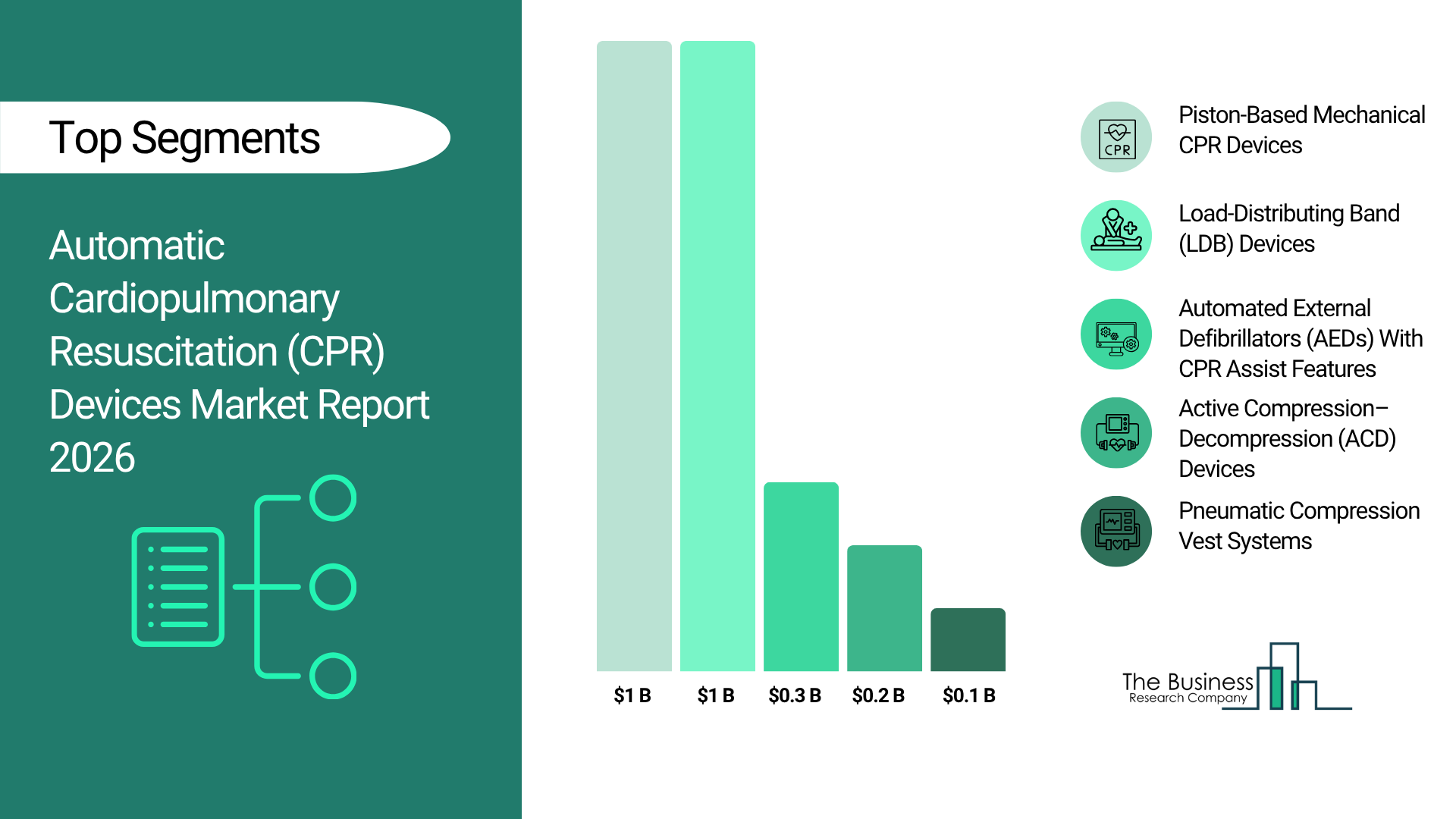
The automatic CPR devices market breaks down into several device categories: piston-based mechanical CPR devices, load-distributing band (LDB) devices, pneumatic compression vest systems, active compression–decompression (ACD) devices, and automated external defibrillators (AEDs) equipped with CPR assist features. Among these, piston-based mechanical CPR devices are projected to be the leading segment, holding about 40% of the market share or $1 billion by 2030. Their strength lies in delivering consistent chest compressions during patient transport, gaining preference for hands-free resuscitation, compatibility with advanced cardiac life support protocols, improved efficiency during extended resuscitation, and widespread procurement by hospitals and ambulance services aiming to enhance patient outcomes.
Additional Market Segmentation by Portability, Technology, Application, and End User
The automatic CPR devices market is further classified by portability into portable and fixed devices. Technology-wise, it includes mechanical, electromechanical, and robotic systems. Application segments encompass cardiac arrest (both out-of-hospital and in-hospital), respiratory failure with secondary cardiac compromise, trauma-related arrest, post-surgical cardiac support, and multi-patient emergency scenarios like mass-casualty events. End users comprise hospitals (emergency departments, ICUs, cath labs), emergency medical services and ambulances, ambulatory surgical centers, public access and first responder units like fire and police, and home care settings.
Forecasted Growth Rate of the Automatic CPR Devices Market Through 2030
The market for automatic cardiopulmonary resuscitation devices is expected to grow at a steady compound annual growth rate (CAGR) of 12% leading up to 2030, signaling robust demand and expanding applications in emergency cardiac care.
Key Factors Propelling Growth in the Automatic CPR Devices Market
A rising number of cardiac arrest incidents worldwide is a major factor accelerating the market’s expansion. This increase stems from higher cardiovascular disease prevalence, aging populations, and lifestyle-related health complications. Automatic CPR devices facilitate continuous, guideline-compliant chest compressions that improve resuscitation effectiveness during critical emergencies. Health systems are prioritizing these advanced technologies to boost emergency response capabilities and improve survival rates, contributing roughly 2.8% annual growth to the market.
Another significant driver is the growing uptake of automatic CPR devices by emergency medical services (EMS) and hospitals. Increasingly, healthcare providers are incorporating these automated systems into emergency departments, ambulances, and intensive care units to standardize and enhance resuscitation quality. These devices allow consistent compressions during transport and extended care, freeing medical staff to focus on other vital interventions. Investments in emergency care infrastructure and critical care equipment further support this trend, adding about 2.5% growth annually.
Rising awareness about the importance of early resuscitation and improved survival outcomes also fuels market growth. Public health campaigns, expanded CPR training, and greater access to sophisticated emergency care promote widespread acceptance of automated resuscitation technologies. Healthcare organizations emphasize evidence-based practices and timely interventions to enhance survival rates. This growing awareness is expected to contribute around 2.3% annual growth to the market.
Opportunities Within the Automatic CPR Devices Market by 2030
Significant growth opportunities lie within segments such as piston-based mechanical CPR devices, load-distributing band (LDB) devices, pneumatic compression vest systems, active compression–decompression (ACD) devices, and automated external defibrillators (AEDs) with CPR assist features. Together, these categories are projected to generate over $0.74 billion in market value by 2030. Drivers include increased adoption of automated emergency response technologies, investments in advanced pre-hospital and critical care infrastructure, emphasis on standardizing resuscitation quality, ongoing product innovations enhancing portability and user-friendliness, and rising demand for dependable life-support equipment across emergency care environments. This momentum highlights the healthcare sector’s focus on improving cardiac arrest survival, reinforcing emergency preparedness, and expanding access to sophisticated resuscitation solutions.
Between 2025 and 2030, the piston-based mechanical CPR devices market is expected to grow by $0.3 billion, the load-distributing band devices by $0.2 billion, active compression–decompression devices by $0.1 billion, AEDs with CPR assist by $0.1 billion, and pneumatic compression vest systems by $0.04 billion. The market is shaped by a mix of global medical device giants and specialized emergency resuscitation technology firms concentrating on automated chest compression, compact portable designs, real-time monitoring, battery life improvements, and seamless integration with emergency medical systems. Consistent compression quality, rapid deployment in emergency settings, clinical reliability, and adherence to international guidelines are key competitive factors. Stakeholders seeking growth and innovation opportunities need to understand this complex and evolving marketplace.
Market Leader in Automatic Cardiopulmonary Resuscitation Devices
Based on recent research, Stryker Corporation led global sales in 2025, holding a 16% market share. Their emergency care product lineup includes advanced mechanical chest compression systems designed to deliver consistent, high-quality CPR, support ongoing resuscitation during transport, and improve efficiency across emergency medical services and hospitals.
Major Companies Steering the Automatic CPR Devices Market
Key participants in this market include Stryker Corporation, ZOLL Medical Corporation, Schiller AG, Nihon Kohden Corporation, Bexen Cardio, Mediana Co. Ltd., SunLife Science LLC, Shenzhen Bangvo Technology Co. Ltd., Inovytec Medical Solutions Ltd., AAT Alber Antriebstechnik, Faith Biotech Co. Ltd., corpuls (GS Elektromedizinische Geräte G. Stemple GmbH), CPR Therapeutics Inc., Landswick Medical Technology Co. Ltd., and Michigan Instruments Inc.
Market Concentration and Competitive Dynamics
The automatic cardiopulmonary resuscitation devices market exhibits moderate concentration, with the top 10 companies responsible for about 35% of total revenue in 2025. This concentration reflects the specialized nature of product development, stringent regulatory requirements, and clinical adoption challenges tied to advanced resuscitation technology. Leading firms maintain strong market positions through comprehensive emergency care portfolios, robust distribution networks, close relationships with healthcare providers, and continuous innovation in automated chest compression technologies. As demand for effective resuscitation systems, better out-of-hospital cardiac arrest management, and enhanced emergency responses grows, these companies are expected to strengthen their competitive edge through product development, strategic alliances, and geographic expansion.
Leading Market Players and Their Shares
The top companies with their respective market shares include:
– Stryker Corporation (16%)
– ZOLL Medical Corporation (8%)
– Schiller AG (3%)
– Nihon Kohden Corporation (3%)
– Bexen Cardio (1%)
– Mediana Co. Ltd. (1%)
– SunLife Science LLC (1%)
– Shenzhen Bangvo Technology Co. Ltd. (1%)
– Inovytec Medical Solutions Ltd. (1%)
– AAT Alber Antriebstechnik (0.4%)
Key Raw Material Providers in the Automatic CPR Devices Market
Important suppliers of raw materials for manufacturing automatic CPR devices include TE Connectivity Ltd., Molex LLC, Amphenol Corporation, DuPont de Nemours, Inc., SABIC, Covestro AG, Celanese Corporation, DSM Engineering Materials, Henkel AG & Co. KGaA, 3M Company, TDK Corporation, Murata Manufacturing Co. Ltd., Analog Devices Inc., Texas Instruments Incorporated, NXP Semiconductors N.V., Panasonic Industry Co. Ltd., RS Components, Flex Ltd., and Jabil Inc.
Prominent Wholesalers and Distributors Serving the Automatic CPR Devices Market
Major distribution and wholesale partners within this market are McKesson Corporation, Cardinal Health Inc., Owens & Minor Inc., Henry Schein Inc., Medline Industries LP, Concordance Healthcare Solutions, NDC Inc., US Med-Equip, CME Corp., Life-Assist Inc., Bound Tree Medical, Sarnova, Avante Health Solutions, DiaMedical USA, Whittemore Enterprises, Mediq B.V., Bunzl Healthcare, Uniphar Medtech, and EMSAR.
Primary End Users of Automatic Cardiopulmonary Resuscitation Devices
Key users of automatic CPR devices include leading healthcare institutions such as Mayo Clinic, Cleveland Clinic, Mass General Brigham, Johns Hopkins Hospital, Kaiser Permanente, HCA Healthcare, Ascension Health, CommonSpirit Health, Apollo Hospitals, Fortis Healthcare, Max Healthcare, AIIMS (All India Institute of Medical Sciences), NHS England Ambulance Trusts, London Ambulance Service NHS Trust, American Medical Response (AMR), Falck A/S, Acadian Ambulance Service, Air Methods Corporation, and Singapore General Hospital.
Emerging Competitive Trends in the Automatic CPR Devices Market
Automated mechanical CPR devices are increasingly revolutionizing emergency resuscitation capabilities. For example, in May 2025, Air Methods Corporation introduced the ZOLL AutoPulse NXT, an automated mechanical CPR device tailored for critical air medical missions. Its compact, X-ray translucent design, ability to provide uninterrupted chest compressions, and compatibility with ECMO and PCI transport protocols enhance resuscitation reliability, speed emergency patient care, and improve survival rates during air medical transport.
Strategies Companies Use to Maintain Market Leadership
Leading firms focus on developing automated mechanical CPR systems that improve consistency and clinical outcomes, designing portable and lightweight devices suitable for emergency and prehospital settings, integrating real-time performance monitoring and feedback features, forming strategic partnerships to expand emergency medical response capabilities and distribution networks, and innovating in battery efficiency and smart connectivity to enhance user experience.
Expanded capabilities in our 2026 market reports:
• Market attractiveness scoring and analysis
• Total addressable market (TAM) analysis
• Company scoring matrix graphics and tables
• Excel-based forecasting dashboards
• Market hotspots infographics
• Key technologies and future trend analysis
• Updated graphics and tables
Learn More About The Business Research Company
The Business Research Company (www.thebusinessresearchcompany.com) is a leading market intelligence firm renowned for its expertise in company, market, and consumer research. We have published over 30,000+ reports across 27 industries and 60+ geographies. Our research is powered by 1,500,000 datasets, extensive secondary research, and exclusive insights from interviews with industry leaders.
We provide continuous and custom research services, offering a range of specialized packages tailored to your needs, including Market Entry Research Package, Competitor Tracking Package, Supplier & Distributor Package and much more.
Disclaimer: Please note that the findings, conclusions and recommendations that TBRC Business Research Pvt Ltd delivers are based on information gathered in good faith from both primary and secondary sources, whose accuracy we are not always in a position to guarantee. As such TBRC Business Research Pvt Ltd can accept no liability whatever for actions taken based on any information that may subsequently prove to be incorrect. Analysis and findings included in TBRC reports and presentations are our estimates, opinions and are not intended as statements of fact or investment guidance.
Contact Us:
The Business Research Company
Americas +1 310-496-7795
Europe +44 7882 955267
Asia & Others +44 7882 955267 & +91 8897263534
Email: marketing@tbrc.info
Follow Us On:
LinkedIn: https://in.linkedin.com/company/the-business-research-company“
Oliver Guirdham
The Business Research Company
+44 7882 955267
info@tbrc.info
Visit us on social media:
LinkedIn
Facebook
X
Legal Disclaimer:
EIN Presswire provides this news content “as is” without warranty of any kind. We do not accept any responsibility or liability
for the accuracy, content, images, videos, licenses, completeness, legality, or reliability of the information contained in this
article. If you have any complaints or copyright issues related to this article, kindly contact the author above.

Media gallery