
Learning Commons announces platform to scale proven teaching and learning practices
PR Newswire
REDWOOD CITY, Calif., Sept. 22, 2026
The new platform aims to improve the quality of technology in education by providing open education datasets and rigorous evaluations
Top organizations, including Canva Education, Really Great Reading, and MagicSchool, join OpenAI and Anthropic in leveraging Learning Commons’ tools to better support students and teachers
REDWOOD CITY, Calif., Sept. 22, 2026 /PRNewswire/ — Today Learning Commons announced its platform, giving organizations focused on building high-quality tools for education access to the datasets, evaluations, and instructional workflows that ground AI in learning science. Canva Education, Level, MagicSchool, OKO Labs, Really Great Reading, and TalkingPoints also announced that they are integrating Learning Commons into their platforms, adding to existing collaborations with Anthropic and OpenAI and demonstrating how Learning Commons has become the essential foundation in developing tools to improve learning.
“We set out to build open, public infrastructure to ensure AI tools truly reflect the science behind student learning. Developed in collaboration with a wide range of partners, today our resources establish a foundation for quality that no single organization could achieve alone,” said Sandra Liu Huang, President of Learning Commons. “The launch of the Learning Commons platform is an open invitation to developers, researchers, and educators to join a community designing and building a future where students and teachers can access high-quality learning tools worthy of their time and trust.”
AI is moving into classrooms faster than the education field can verify its quality. General-purpose models can generate educational content, but they are not grounded in what students should learn, how concepts develop, where learners struggle, or what strong instruction requires. Until now, every organization building with AI has had to close these gaps alone, rebuilding the same educational foundation at significant cost and with expertise most teams do not have.
Learning Commons is an infrastructure layer that provides open, machine-readable educational data, research-backed evaluation, and instructional workflows that any builder can use, so the whole field can raise the quality of AI in education together. By building open, shared tools and resources, we empower the development of instructionally sound and rigorous educational products grounded in learning science.
Importantly, Learning Commons’ infrastructure is designed to work behind the scenes to support the development and improvement of education tools and resources. Designed to work without student data, the platform provides open, transparent educational data, evaluation tools, and instructional resources that all organizations can use to improve the quality and effectiveness of the tools teachers rely on in their classrooms.
What developers can access today
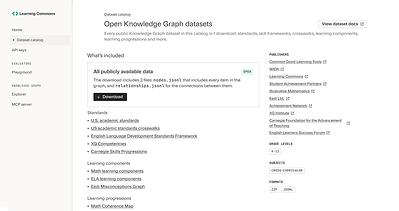
The platform makes it easier to discover, explore, and access our Knowledge Graph datasets and Evaluators. Knowledge Graph brings together structured K–12 education data, including state academic standards, granular learning components, learning progressions, common learning misconceptions, curricula, and durable skills, so developers can give AI systems more reliable context about what students are expected to learn, how concepts build over time, and where learning can break down. Evaluators are research-backed tools that help developers measure the quality of AI-generated educational content against expert-informed rubrics, including dimensions such as grade-level appropriateness, alignment with state academic standards, feedback quality, and instructional rigor. By leveraging these tools, developers can build more effectively without having to recreate high-quality, foundational components, helping provide students and educators with the tools and materials they need and deserve to succeed.
New key capabilities include:
- New Knowledge Graph datasets. The platform now has Eedi’s Misconception Graph, an open-source public good, supported by the Gates Foundation, to help tools diagnose the specific misconceptions behind wrong answers and understand why students struggle in math. This builds on Knowledge Graph’s existing foundation of high-quality curricula, state academic standards, learning progressions, and durable skills datasets.
- New Evaluator helps developers assess quality. The new Durable Skills Evaluator assesses how well tools support students in developing critical thinking skills to find, evaluate, and reason from evidence to build an argument. Grounded in learning science, this addition strengthens our evaluation suite to better capture the full range of competencies required for comprehensive learner development, alongside existing Evaluators for math standard alignment, writing feedback, grade-level appropriateness, and text complexity.
- Soon-to-be-released Agent Skills. Later this year, we will release additional agent skills designed to support teacher planning. Agent skills translate research and instructional expertise into open, reusable workflows for common teaching and learning tasks, such as lesson planning, differentiation, and checking for understanding. Developers can incorporate or adapt these skills in their own AI products rather than designing instructional tasks from scratch. The new skills will range from helping audit lesson plans and formative assessments for quality to producing short decodable passages using text students have been taught. These additions deepen our commitment to pedagogical rigor and learning science by complementing our existing skills, co-developed with Anthropic—Lesson Plan Creation, Lesson Differentiation, Lesson Prep, and Check for Understanding—to translate essential instructional practices into reusable, educator-centered workflows that help developers create more effective AI products.
“For over a decade, Eedi has been building the Misconception Graph, a structured map of mathematical concepts and the common misconceptions associated with them. As a component of our Diagnostic Engine, it provides granular and data-backed insights into what students know and why they struggle. By open-sourcing this layer of diagnostic insight, Eedi looks forward to more global collaborations that support our mission of reaching a billion learners across different countries, contexts, and languages,” said George Mu, President and Chief Growth Officer at Eedi.
New partners
Leading companies are already using Learning Commons to make their products more trustworthy, reliable, and impactful for teaching and learning. Each applies the same underlying educational expertise in a different way. These partnerships build on our existing collaborations with organizations like Anthropic and OpenAI, where we are working to reinforce frontier models with high-quality educational data to better support instruction and student learning. They also build on our established work with other research and education organizations dedicated to advancing learning science and instructional quality. Check out our partnerships page to learn more about the researchers, developers, and educators collaborating with us.
Today, we are announcing new partnerships with Canva Education, Level, MagicSchool, OKO Labs, Really Great Reading, and TalkingPoints.
Canva Education, a 100% free interactive learning platform, uses datasets from Knowledge Graph to build instructional content aligned with state academic standards and the underlying learning components and progressions, helping teachers find resources that are instructionally sound and relevant to what they teach. For example, a teacher using Canva Education to craft a lesson can ensure the materials they create are grounded in their local academic standards.
“With the Learning Commons partnership, teachers spend less time stitching together resources and more time with their students. Learning Commons brings deep expertise in learning science and standards, and that expertise is now built into Canva’s education content and our new math mini-lessons, so every lesson is grounded in real standards and learning progressions from the start. By connecting Canva’s creation tools with their curriculum infrastructure, we’re making it easier for teachers to find, adapt, and use instructional materials that actually match what they teach. This is just the start. We’re bringing the same approach to more subjects and more of Canva Education’s ready-to-teach resources as the partnership grows,” said Carly Daff, Head of Canva Education.
Level, an Austin-based educational technology startup, enables the creation of cutting-edge interactive digital services that map directly to state academic standards and specific skills through Knowledge Graph and text evaluators.
MagicSchool, a leading AI platform for schools, has worked with Learning Commons to explore how education-specific resources can support the development of high-quality AI tools for educators. The collaboration has helped inform MagicSchool’s thinking around educational standards and knowledge structures as it continues to build AI experiences designed specifically for K–12 schools.
“AI has so much potential to help teachers reach every student, but it has to be developed with an understanding of how schools work and what educators need. That’s been core to how we’ve built MagicSchool from day one, and it’s why we’re glad to work with Learning Commons as they create resources that help make AI more useful and trustworthy for education,” said Adeel Khan, Founder and CEO, MagicSchool.
OKO Labs, an AI-powered platform that facilitates small-group collaborative learning, is using Knowledge Graph to align its content with math learning components and to ground its feedback and measurement of durable skills, like communication, collaboration, and critical thinking. Teachers and students get a research-backed read on both the math standards a group is working on, and the durable skills named in their school district’s portrait of a graduate.
Really Great Reading (RGR), an education outcomes company changing the trajectory of literacy for students from kindergarten through high school, will release its next-generation Literacy Outcomes System (LitOS™) this fall, which includes Knowledge Graph as a learning science–grounded component to ensure students have the literacy skills needed to succeed.
“As we all focus on helping students learn in a rapidly modernizing world, shared public resources built on learning science like Knowledge Graph help us move from pockets of excellence to systems of achievement,” said Karl Rectanus, CEO of RGR. “Our team at RGR is excited to truly partner with Learning Commons –both as a contributor and a beneficiary—and education leaders across the country, on this important work to change the trajectory of literacy.”
TalkingPoints, which builds on the power of family-school partnerships to improve student outcomes, draws on Knowledge Graph curriculum and math learning components to generate lesson-aligned activities that connect what students are learning in class to academically grounded support at home — with instructions and activities translated into 150+ languages so every family can take part.
This launch is a milestone, not an endpoint. Learning Commons will continue expanding Knowledge Graph datasets, Evaluators, and agent skills in collaboration with educators, researchers, and developers. Developers can create a free Learning Commons account and start exploring the platform today.
Launched in 2025, Learning Commons builds on the Chan Zuckerberg Initiative’s decade of work advancing learning science and translating research into classroom practice. Through shared, open technological infrastructure built for the public good, Learning Commons aims to better connect the way students learn with the tools they use.
Media Contact:
press@learningcommons.org

 View original content to download multimedia:https://www.prnewswire.com/news-releases/learning-commons-announces-platform-to-scale-proven-teaching-and-learning-practices-302885585.html
SOURCE Learning Commons


