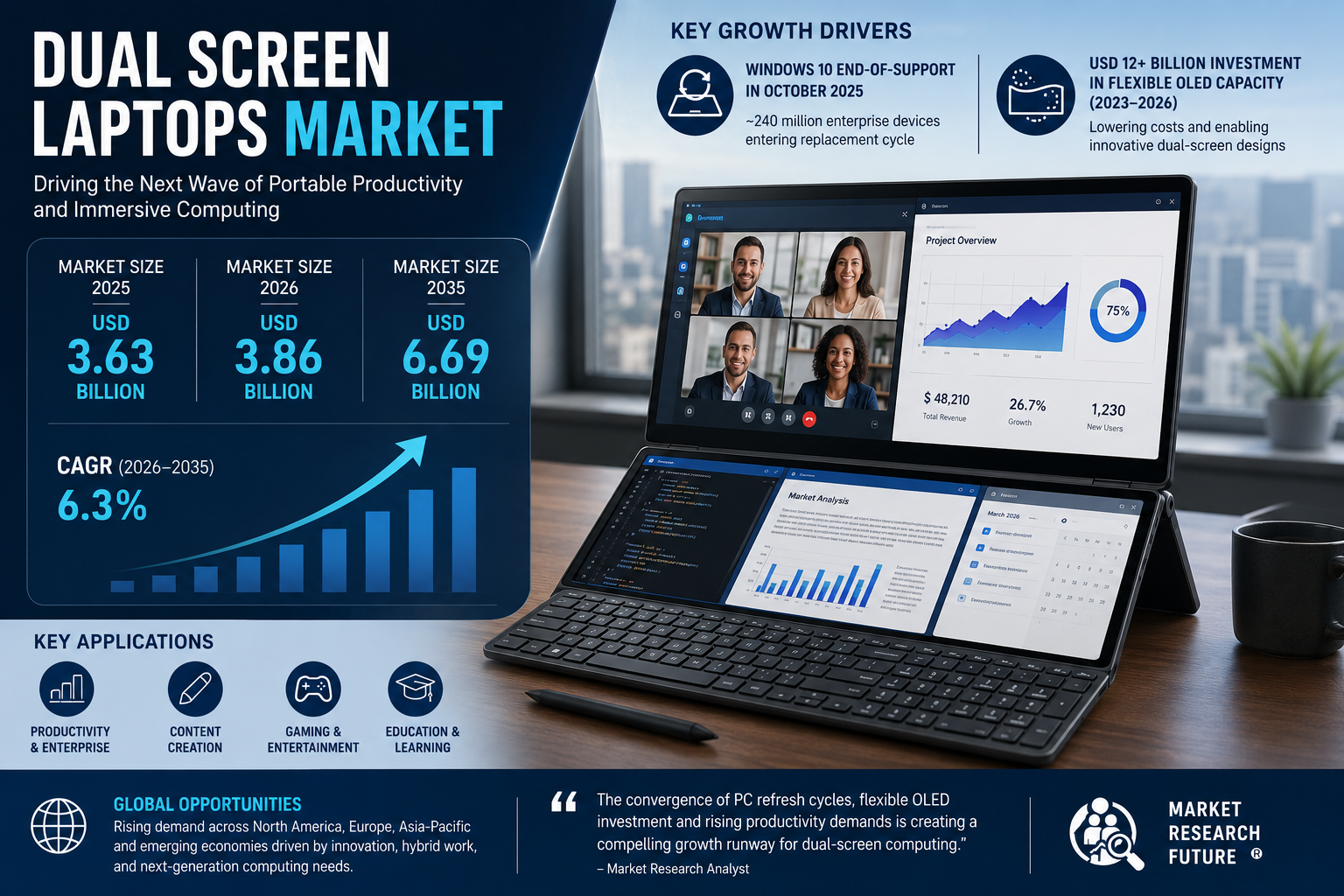
Rising productivity needs, premium PC refresh cycles and declining flexible-display costs position dual-screen laptops for sustained global growth through 2035.
NEW YORK, NY, UNITED STATES, August 31, 2026 /EINPresswire.com/ — The global Dual Screen Laptops Market is entering a period of sustained expansion as consumers, enterprises, creative professionals and technology enthusiasts increasingly seek portable computers that deliver larger digital workspaces without the footprint of a conventional multi-monitor setup.
The market closed 2025 at approximately USD 3.63 billion and is projected to reach USD 3.86 billion in 2026, before advancing to approximately USD 6.69 billion by 2035, representing a 6.3% compound annual growth rate (CAGR) during the forecast period. The growth trajectory reflects a convergence of hardware innovation, changing workplace requirements, display technology advances and a renewed global PC replacement cycle.
Dual-screen laptops are moving beyond the experimental category of premium computing products and increasingly becoming part of a broader evolution in portable productivity. By combining two integrated displays in a single computing platform, these devices enable users to work across multiple applications, reference information while creating content, monitor communications alongside primary workflows and adapt screen configurations to different tasks.
The category is particularly relevant to professionals who regularly work across multiple applications, including designers, developers, financial analysts, content creators, engineers, researchers and business users. Gaming and education are also emerging as important application areas as manufacturers experiment with new form factors, touch interfaces, stylus support, flexible displays and software designed specifically for multi-screen workflows.
PC REPLACEMENT CYCLE CREATES A NEW WINDOW FOR PREMIUM DEVICES
One of the most significant catalysts supporting the market is the global PC replacement cycle associated with the end of Windows 10 support in October 2025.
Industry estimates have indicated that roughly 240 million PCs could be incompatible with Windows 11, creating substantial pressure for organizations and users to assess replacement, upgrade and extended-support options. The transition has encouraged enterprises to revisit device fleets and evaluate new hardware based not only on basic computing performance but also on productivity, mobility, security and long-term return on investment.
For PC manufacturers, this replacement cycle creates an opportunity to differentiate premium devices from conventional notebook upgrades. Rather than replacing an aging laptop with a similar configuration, businesses and consumers can increasingly consider hardware that provides additional functionality and improved workflow efficiency.
Dual-screen laptops can address this demand by offering expanded workspace in a portable form factor. A professional may use one display for a primary application and the second for research, communications, dashboards, reference documents or collaboration. For creative professionals, the secondary display can function as a control surface, timeline, tool panel or reference canvas.
As organizations modernize hardware fleets, the value proposition of premium computing devices is therefore shifting from specifications alone toward productivity and workflow optimization.
Get Full PDF Sample Copy of Report: (Including Full TOC, List of Tables & Figures, Chart) @ https://www.marketresearchfuture.com/sample_request/22339
FLEXIBLE OLED TECHNOLOGY SUPPORTS PRODUCT INNOVATION
Display technology is another major factor influencing the development of the dual-screen laptop segment.
Flexible OLED technology has enabled manufacturers to explore new form factors that were previously difficult or uneconomical to produce at scale. Flexible displays can support foldable and convertible designs while offering high contrast, thin profiles and improved visual quality. As display manufacturers expand production capabilities and invest in flexible OLED capacity, economies of scale can gradually improve the commercial viability of next-generation laptop designs.
Industry investment of more than USD 12 billion in flexible OLED capacity between 2023 and 2026, as cited in the market outlook underpinning this release, represents an important development for device manufacturers. Greater panel availability and improving manufacturing economics can give original equipment manufacturers more flexibility when designing products for mainstream and premium price segments.
Lower component costs could also help dual-screen configurations move beyond ultra-premium products. Historically, multiple displays, specialized hinges, flexible panels, thermal management requirements and customized software have contributed to higher manufacturing complexity. Continued development across the display supply chain can help address these constraints.
The result is a market in which manufacturers can experiment with multiple configurations, including traditional dual-panel notebooks, foldable devices, detachable secondary displays and hybrid form factors designed around specific professional workflows.
PRODUCTIVITY REMAINS A CENTRAL MARKET DRIVER
Productivity is expected to remain one of the strongest applications for dual-screen laptops.
The modern workforce increasingly relies on simultaneous access to documents, communication platforms, cloud applications, analytics dashboards and specialized software. Conventional laptops require users to repeatedly switch between windows or connect external monitors when more screen real estate is required.
Dual-screen laptops offer an alternative by integrating additional workspace directly into the mobile computing platform.
For enterprise users, the additional screen can support video conferencing, data visualization, customer relationship management, financial analysis, coding, project management and document review. For consultants and mobile professionals, integrated multi-screen capability can reduce reliance on external monitors while working from hotels, client offices, airports or temporary workspaces.
The hybrid-work environment has reinforced the importance of portability without sacrificing productivity. Employees increasingly expect laptops to support workloads that previously depended on desktop workstations or fixed multi-monitor environments.
This shift gives dual-screen manufacturers an opportunity to position their products not simply as premium laptops, but as mobile productivity systems.
CONTENT CREATION AND CREATIVE WORKFLOWS EXPAND OPPORTUNITIES
Content creation represents another attractive growth area.
Video editors, photographers, graphic designers, music producers, 3D artists and other creative professionals frequently require multiple panels, toolbars and reference windows while working on a primary canvas. A dual-screen laptop can dedicate one display to the creative workspace and the other to editing controls, asset management, timelines or reference material.
The continued growth of digital content, creator economies and independent media production is creating demand for increasingly capable mobile workstations. Manufacturers that can optimize dual-screen hardware for professional software ecosystems may be able to capture specialized segments willing to pay a premium for productivity gains.
Software optimization will be particularly important. Hardware alone does not guarantee a superior dual-screen experience. Operating systems, application developers and OEMs must ensure that displays interact intelligently and that applications can recognize, resize and distribute content effectively.
Features such as automated window placement, application-specific layouts, touch and stylus controls, virtual keyboards, intelligent display orientation and AI-assisted workflow management could help differentiate future products.
GAMING AND ENTERTAINMENT APPLICATIONS CREATE ADDITIONAL DEMAND
Gaming is also contributing to interest in multi-display portable computing.
Gamers can benefit from additional screen real estate for streaming controls, game information, communication tools, system monitoring and content management. A second display can allow users to maintain access to chat, streaming software or game-related information without interrupting the primary gaming experience.
Manufacturers are also exploring ways to combine high-refresh-rate panels, advanced graphics processing, efficient thermal systems and immersive display configurations in premium gaming laptops.
However, gaming adoption will depend on the ability of manufacturers to balance performance with portability, battery life, weight and thermal management. These considerations remain critical barriers to mass-market adoption and will shape product development throughout the forecast period.
EDUCATION AND PROFESSIONAL TRAINING PRESENT NEW USE CASES
Education is another application where dual-screen laptops can provide meaningful functionality.
Students can use one screen for coursework, virtual classrooms or productivity applications while using the second display for research, note-taking, reference material or collaboration. In higher education, specialized applications in engineering, architecture, medicine, design and data science can benefit from larger digital workspaces.
Educational institutions are also increasingly evaluating computing devices according to total productivity rather than hardware specifications alone. If dual-screen systems demonstrate measurable advantages in learning, research and collaboration, institutional procurement could become an additional source of market demand.
The broader shift toward digital education and hybrid learning environments provides a foundation for manufacturers to develop specialized configurations aimed at students, educators and professional training programs.
DISPLAY TECHNOLOGY SEGMENTATION
The Dual Screen Laptops Market is evolving across several display technologies, including IPS LCD, OLED, Mini LED and E-Ink.
OLED is expected to receive significant attention because of its ability to support thin, lightweight and flexible designs while delivering high-quality visual performance. Mini LED can appeal to premium users seeking high brightness and strong contrast, while IPS LCD remains relevant because of its established manufacturing ecosystem and potentially lower cost.
E-Ink-based secondary displays may also find specialized applications where low power consumption and long viewing times are important.
Display size represents another important area of differentiation. Manufacturers can offer compact dual-screen configurations designed for portability, as well as larger models aimed at professionals who prioritize workspace over weight.
This segmentation allows OEMs to target different customer groups rather than treating dual-screen computing as a single standardized product category.
REGIONAL MARKET OUTLOOK
North America is expected to remain an important market for premium dual-screen computing, supported by strong enterprise technology adoption, high spending on professional hardware and demand from creative and technology-intensive industries.
Europe represents another significant opportunity, particularly as organizations continue modernizing workplace technology and consumers demonstrate interest in energy-efficient and innovative computing products. Manufacturers with strong sustainability credentials may find additional opportunities as buyers increasingly consider device lifecycle and energy efficiency.
Asia-Pacific is expected to play a critical role in the long-term development of the market because of its extensive electronics manufacturing ecosystem, growing technology consumption and concentration of display and component suppliers. Countries including China, Japan, South Korea and Taiwan are central to the broader laptop, semiconductor and display supply chain.
Emerging markets across Latin America, the Middle East and Africa may experience more gradual adoption, with price sensitivity likely to remain an important consideration. As component costs decline and product availability expands, these markets could provide incremental opportunities for manufacturers.
COMPETITIVE LANDSCAPE AND PRODUCT DIFFERENTIATION
The competitive environment is expected to remain focused on product differentiation, display innovation, industrial design and software integration.
Major technology companies including ASUS, Lenovo, HP, Dell, Microsoft, Acer, Razer, Samsung and LG are among the companies associated with the broader laptop and display innovation ecosystem. Market participants are expected to compete through new form factors, premium displays, AI-enabled features, improved battery performance and application-specific functionality.
The ability to establish a strong software ecosystem may become as important as hardware innovation. Dual-screen devices require optimized user interfaces and application support to deliver their full productivity potential. Manufacturers that can combine hardware, software and AI capabilities into cohesive workflows could gain a competitive advantage.
Partnerships with display manufacturers, processors, operating-system developers and enterprise software providers may therefore become increasingly important.
CHALLENGES COULD MODERATE MASS-MARKET ADOPTION
Despite the positive outlook, several challenges remain.
Dual-screen laptops generally involve greater engineering complexity than conventional notebooks. Specialized hinges, multiple panels, increased power requirements, thermal considerations and structural durability can add to manufacturing costs.
Battery efficiency remains particularly important. Two active displays can increase energy consumption, making power optimization essential for users who rely on mobile computing throughout the working day.
Price is another potential constraint. Consumers may hesitate to pay a substantial premium for a second display unless the productivity benefits are immediately clear.
Manufacturers must also address durability and repairability. Foldable and flexible components introduce additional engineering requirements, while consumers increasingly expect premium devices to offer long service lives.
These challenges mean the market’s growth will depend not only on technological advancement but also on manufacturers’ ability to demonstrate practical value at commercially attractive price points.
AI COULD REDEFINE THE DUAL-SCREEN EXPERIENCE
Artificial intelligence is expected to become an important component of future dual-screen laptops.
AI-enabled operating systems could automatically organize applications across displays based on user behavior and workflow. A system could, for example, place a video conference on one screen while maintaining notes, documents or project information on the second.
AI assistants could also summarize documents, organize research, monitor productivity applications and automate repetitive tasks across the two-display environment.
This creates an opportunity for dual-screen laptops to evolve from hardware products into intelligent workspace platforms.
As AI PCs become more widespread, manufacturers may increasingly use the second display as a dedicated interface for AI tools, contextual information and productivity controls.
FUTURE OUTLOOK
The Dual Screen Laptops Market is positioned at the intersection of several long-term technology trends: mobile productivity, premium PC replacement, flexible display innovation, hybrid work, content creation and AI-powered computing.
From a market value of USD 3.63 billion in 2025, the sector is projected to reach USD 3.86 billion in 2026 and approximately USD 6.69 billion by 2035, reflecting a 6.3% CAGR over the forecast period.
The combination of PC replacement demand and improving flexible-display economics provides manufacturers with a favorable environment for continued product development. At the same time, growing expectations for portable productivity and multitasking are creating a broader consumer rationale for multi-display computing.
The next phase of market development is likely to focus on reducing device thickness and weight, extending battery life, improving hinge durability, lowering display costs and developing software that makes two-screen workflows intuitive.
As these improvements converge, dual-screen laptops could transition from a niche premium category into a more established segment of the global personal-computing market.
The market’s long-term success, however, will ultimately depend on whether manufacturers can demonstrate that the second display provides tangible productivity and usability benefits rather than serving primarily as a novelty feature.
With display technology advancing, enterprise PC fleets undergoing modernization and users demanding greater flexibility from mobile computing devices, dual-screen laptops are positioned to capture a growing share of innovation-focused PC spending through 2035.
Discover Related Research Reports By Market Research Future:
Laptop Skins Market
https://www.marketresearchfuture.com/reports/laptop-skins-market-10372
Playstation Market
https://www.marketresearchfuture.com/reports/playstation-market-22446
Military Display Market
https://www.marketresearchfuture.com/reports/military-display-market-32808
Market Research Future
Market Research Future
+1 855-661-4441
email us here
Legal Disclaimer:
EIN Presswire provides this news content “as is” without warranty of any kind. We do not accept any responsibility or liability
for the accuracy, content, images, videos, licenses, completeness, legality, or reliability of the information contained in this
article. If you have any complaints or copyright issues related to this article, kindly contact the author above.

Media gallery